The FDA published a pivotal update to its Cyber Security guidelines for medical devices. The guidance supersedes all previous versions, and it represents the formal alignment of cybersecurity requirements with the Quality Management System Regulation (QMSR), which became effective on February 2, 2026. For Original Equipment Manufacturers (OEMs), this shift marks the end of the voluntary era and the beginning of a landscape where cybersecurity is a statutory prerequisite for market access.
The urgency behind the 2026 update is driven by the dramatic increase in healthcare-targeted cyberattacks and discovery of software vulnerabilities and systemic flaws in medical products. Between 2023 and 2025, the industry witnessed a perfect storm of security failures, including the 2024 Change Healthcare ransomware attack that paralyzed national clinical workflows and the exploitation of critical vulnerabilities in medical imaging software and infusion pumps. Data from 2025 indicated that nearly 99% of hospitals were managing Internet of Medical Things (IoMT) devices with at least one Known Exploited Vulnerability (KEV), while FBI reports revealed that over 50% of networked medical devices carried critical security flaws. These incidents, often rooted in unpatched legacy systems and weak third-party library management, forced the FDA to transition from advisory recommendations to the strict, enforceable mandates we see today.
The following subsections highlight the most important aspects of the revised FDA guidance.
1. From QSR to QMSR
The most significant change in the 2026 guidance is the structural alignment with ISO 13485:2016. While previous versions referenced the old Quality System Regulation (QSR), the 2026 update fully integrates the Quality Management System Regulation (QMSR) which reflects an effort to harmonize medical device standards to ensure that cybersecurity is treated with the same rigor as physical sterilization or mechanical integrity. This includes the following:
- Design Controls: Cybersecurity must be integrated into your broader QMS under 21 CFR Part 820.
- Integrated Documentation: Security risk management must map directly to your ISO 13485-compliant quality processes.
- Safety as Security: The FDA no longer views security as a standalone IT concern but rather a core part of device safety and integrated into the product lifecycle.
By embedding security into the QMSR, the FDA has ensured that cybersecurity is now legally inseparable from the fundamental safety and efficacy of a medical device.
2. Key Differences from Previous Versions
Comparing the 2026 guidance to the 2023 and 2025 predecessors, it reveals that there is a significant tightening of enforcement and a broadening of regulatory scope. In the past, manufacturers often benefited from refuse to accept (RTA) discretion during transitional periods, but those grace periods have officially expired. The updates include:
- Strict Enforcement: Non-compliance with Section 524B is now a direct Refuse to Accept (RTA) criterion.
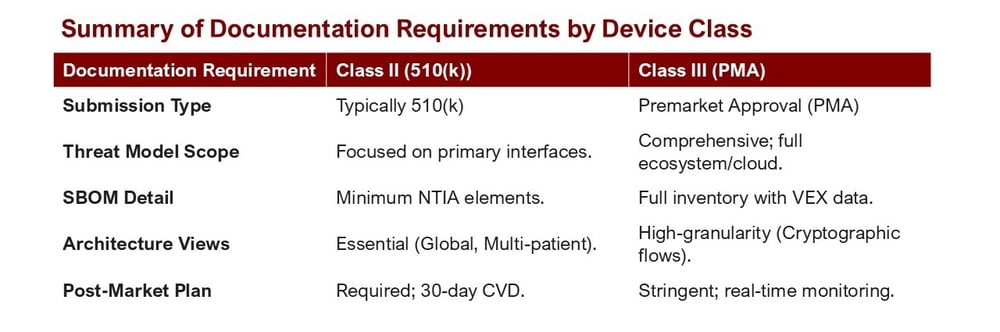
- Mandatory SBOM: OEM's must provide a machine-readable Software Bill of Materials including all third-party and open-source components.
- Standardized Modules: Submissions now require 12 specific cybersecurity modules via the eSTAR portal.
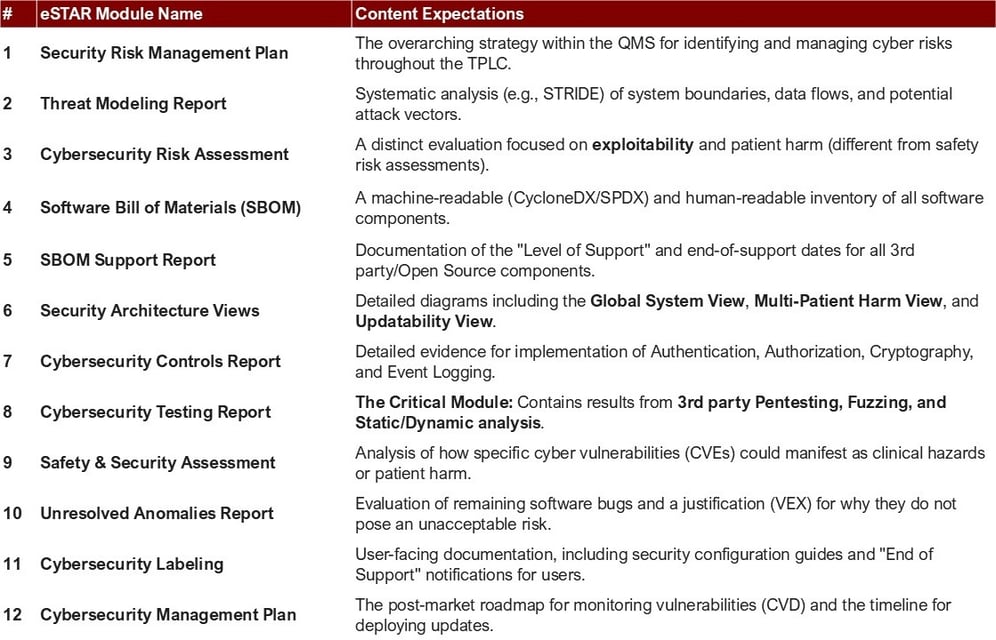
The transition from flexible recommendations to rigid, standardized submission requirements means that technical debt in legacy security processes is now a direct barrier to market entry.
3. Critical Focus Areas for OEMs
The FDA has moved toward a more granular, architectural review of devices, requiring OEMs to prove resilience through multiple views of the system. This section of the guidance emphasizes that connectivity triggers the full weight of the Cyber Device definition.
- Global System Architecture View: Provides a detailed must of all internal and external connections, including Bluetooth, Wi-Fi, and Cloud.
- Multi-Patient Harm View: A safety analysis explaining how you prevent an exploit from scaling across thousands of devices simultaneously. Here is where your product Security Architecture, Safety & Security Assessment and Cyber Security Risk Assessment documents demonstrate how you leverage concepts related to Defense-in-Depth and Zero-Trust.
- Updatability View: Detailed documentation of the end-to-end process for deploying patches and handling rollbacks.
OEMs must now provide a transparent, multi-dimensional map of their device’s architecture to prove that a single point of failure cannot result in widespread patient harm.
4. The SPDF: A Lifecycle Mandate
The FDA is now strictly enforcing the Secure Product Development Framework (SPDF), moving the industry away from point-in-time security testing. This framework demands that security activities occur continuously throughout the products life and includes:
- Threat Modeling: Must be performed during the design phase, not retroactively for a submission.
- VEX (Vulnerability Exploitability eXchange): You must provide transparency regarding unresolved vulnerabilities and why they don't pose a risk.
- Post-Market Management: Submissions must include a plan for Coordinated Vulnerability Disclosure (CVD) with rapid remediation windows.
A medical product is no longer considered cleared for its entire lifespan unless the manufacturer maintains an active, audited framework for continuous security monitoring and rapid patching.
5. Independent Validation: VA vs. Penetration Testing
Under the 2026 QMSR context, the FDA distinguishes between Vulnerability Assessments (VA), which ensure "hygiene" by scanning for known bugs (CVEs) and Penetration Testing, which is a targeted, adversarial exercise. To meet the 2026 rigor, a 3rd-party firm must possess deep expertise across the entire device stack, moving beyond simple network scans to interrogate hardware interfaces (JTAG, UART), firmware integrity, and complex signaling protocols like BLE or 5G. This specialized experience ensures that hidden vulnerabilities, such as insecure boot processes or unencrypted inter-processor communication are identified before they become liabilities in a regulatory submission. The updated FDA guidance aims to address the following:
- Evidence of Independence: 3rd parties provide a "Statement of Independence" that satisfies QMSR requirements for unbiased validation.
- Threat Model-Driven Scope: Testing must be mapped to the OEM’s unique attack surfaces, not just generic checklists.
- Hardware & Firmware Rigor: Testing must include physical interfaces (UART, JTAG) to satisfy the "Cyber Device" definition.
Utilizing a 3rd party for penetration testing ensures that the "Independence and Technical Expertise" requirement of the 2026 FDA guidance is met with maximum transparency and zero conflict of interest.
Conclusion
The 2026 FDA guidelines represent a fundamental shift in the definition of a "market-ready" medical device. Success is no longer achieved by merely checking a box on a submission form bur rather, it requires a cultural and structural evolution where cybersecurity is treated as a clinical vital sign. OEMs must move away from the siloed approach of the past where engineering, quality, and security teams operated independently and adopt a holistic "Security-First" lifecycle. This means embracing the 2026 QMSR requirements as a core competency rather than a regulatory hurdle, evidence of product resilience, offering transparency through SBOM and partnering with a security vendor who has the required skillset and experience to produce regulatory grade evidence for successful clearance.


 Palindrome Technologies
 Palindrome Technologies : Jul 3, 2026, 1:01:20 PM